Matthew Boyd, Assistant Professor of Teaching
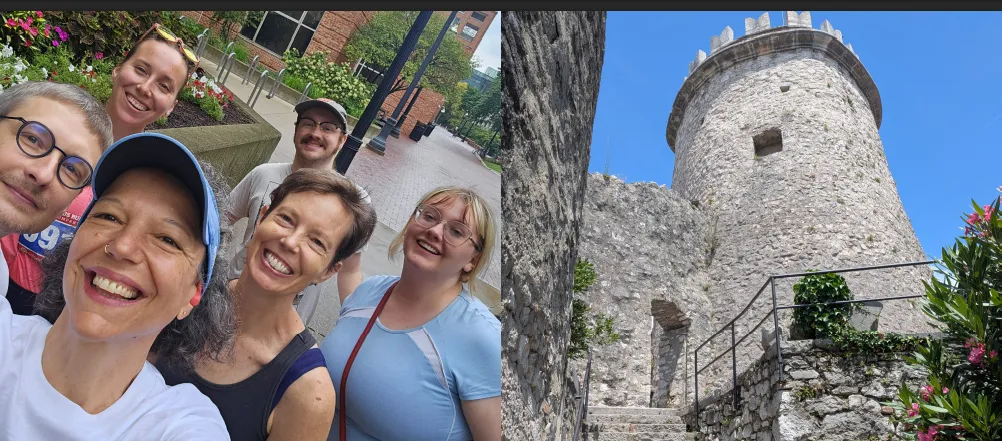
Following two weeks of research in Ljubljana, Slovenia while on the Slovene Research Initiative, Dr. Boyd met with fellow BCMS pedagogues in Croatia, Bosnia and Herzegovina and Serbia this summer to explore expanded possibilities for Ohio State students who want to study abroad in the Balkans. The contacts he made will be helpful in crafting future student study abroad experiences, as well in day-to-day course design. Serendipitously, his visit to Sarajevo coincided with one of Bosnia’s World Cup championship matches, an event which electrified the city. Too much in the sun, Dr. Boyd drew inspiration from similar examples of indomitability and inventiveness throughout his trek across Slovenia, Croatia, Bosnia and Herzegovina and Serbia during this altogether too-hot summer.
Yana Hashamova, Arts and Sciences Distinguished Professor
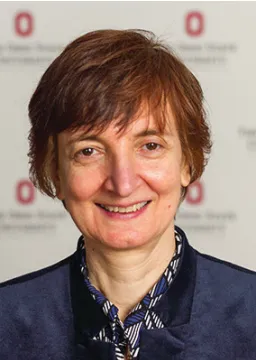
Professor Yana Hashamova received the 2025 American Association of Teachers Slavic and East European Languages (AATSEEL) Outstanding Contribution to the Profession Award, an honor recognizing individuals whose scholarly leadership, mentorship and service have had a transformative impact on the field of Slavic, East European and Eurasian studies. The award acknowledges her sustained commitment to creating new opportunities for scholarship and teaching, expanding the public reach of humanities and mentoring graduate students and emerging scholars. In addition to this national recognition, this year Hashamova serves in a leadership role with The Ohio State University’s Global Arts and Humanities Research Exchange - Society of Fellows, where she guides faculty and students engaged in interdisciplinary research on the theme “Cultures in Motion.” Through workshops and seminars, she helps cultivate new conversations about mobility, identity and cultural transformation across global contexts. These endeavors are closely connected to her monograph in development, Resentment Abroad: Diaspora and the Making of Post-Socialist Populism, which examines how diasporic culture and daily experiences shape political behavior and contribute to the recent rise of populist movements in Eastern Europe

Alisa Ballard Lin , Associate Professor
I’m a scholar of East Central European theater. I’m presently excited about my forthcoming co-edited volume titled Performing Refuge and Risk: Precarious Theatre in East Central Europe. The book features chapters on theater’s engagements with political, social, sexual, and ethnic precarity in this region where borders have constantly shifted and identities have regularly been challenged. The book also includes interviews with theatre makers persisting through the war against Ukraine. This semester I’m teaching related content in my course Theatre, Identity and Citizenship in Eastern Europe. Half the class time is devoted to student-led studio work on scenes from our plays. In the spring for the first time I’ll be teaching my course East European Fashion: Trends, Textiles and Traditions. Fashion history and theory have become a deep interest of mine. Clothing is a material object that interacts intimately with the human body and with human identity. In Eastern Europe clothing has closely reflected politics, culture, art and global relations. While I am currently writing a book on intersections of theatrical and Christian belief in East Central Europe, I’m eager to write about East European apparel in the future.
Laura Siragusa, Assistant Professor of Teaching
On September 20, 2026, several students, faculty and staff, coordinated by SEELC Interim Chair Jennifer Suchland, took part in the inaugural Love of Languages 5K Run/Walk. We were there not only to celebrate our love of languages, but also to connect with the broader Ohio State community, from our departments and centers to friends, colleagues and new acquaintances. Some came ready to compete, while others were happy to enjoy the walk, the weather, and good conversation. We gathered near the Buckeye Bike Hub, soaked up the great energy, and before long, we were off! Uphill, downhill, flat stretches, overtaking and being overtaken... and finally, the finish line. Siobhán Seigne led the SEELC group with a 44th-place finish (5th in her gender category), followed by Mitchell Baughman in 56th place. I did okay, too, finishing 116th overall and 2nd in my gender-and-age group. Everyone crossed the finish line showing not only competitive spirit, but also a strong commitment to our linguistic community. With ice cream, water bottles, and towels waiting at the end, it was a wonderful day, and I hope the Love of Languages 5K becomes a yearly tradition that brings us together under the banner of “Love of Languages!”
Larysa Stepanova, Language Program Director

As Director of Language Programs, Dr. Stepanova participated in numerous recruitment events to engage prospective students and their families to discuss academic opportunities, language programs and career pathways available through our department. To remain current with Ohio State’s growing emphasis on AI literacy, she and Dr. Andrei Cretu developed the course Russian with AI: Mastery Through Technology, which integrates artificial intelligence tools into language learning and helps students develop both linguistic and technological competencies. Dr. Stepanova also contributed to a collaborative research project on linguistic data annotation and analysis that resulted in the publication by Gasparini, L. et al., Automated parts-of-speech tagging in 52 language varieties: Benchmarking towards establishing suitability for multilingual clinical language analysis. Go Bucks!
Diana Sacilowski, Assistant Professor of Teaching
I’m starting my sixth year at Ohio State, and while I love teaching Polish language, I am particularly excited to be teaching Polish 5230 for the first time in fall 2026. I’ve decided to focus the course on the Jewish “return” in Poland, a topic that I’ve been studying for well over a decade. Students are engaging with iterations of this late/post-Communist trend in literature, film, and memorial projects and evaluating its role in subverting traditional narratives of identity, while learning about some key tenets of memory studies. I’ve developed a Polish-Jewish film series, Returns, to run in conjunction with the course, which should give students, and the general public, even more insight into this important cultural movement. I’m also excited to share that an article I’ve written analyzing Piotr Szewc’s Annihilation, a key text of the Jewish “return,” will be published in Polin: Studies in Polish Jewry in early 2027
Saul Zaritt, Assistant Professor
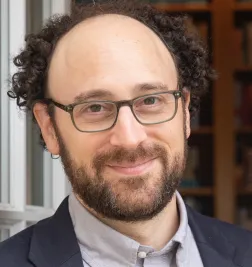
Dr. Saul Zaritt has been invited to give the prestigious Stroum Lectures at the University of Washington, Seattle, in May 2027. His three lectures will be on the topic of Jews and popular culture, investigating how varying and sometimes competing notions of Jewishness function in the public sphere. He will talk about "famous Jews” and why that fame endures; how the figure of the Jew, as stereotype or symbol, appears in popular culture, from classical mystery novels to American humor and romance; and how writers have translated seemingly foreign popular genres and cultural forms into Jewish languages.